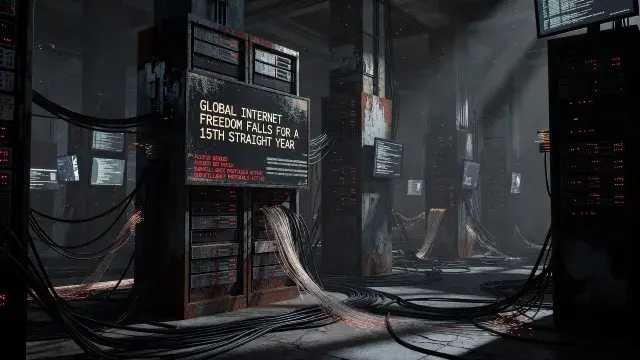
Internet freedom worldwide has deteriorated for the fifteenth consecutive year, according to Freedom House's newly released Freedom on the Net 2025 report. Of the 72 countries assessed, conditions worsened in 27 and improved in only 17, with China and Myanmar once again ranked as the worst environments for online expression and access, while Iceland retained its position as the most free. The report's findings carry weight well beyond authoritarian states, pointing to a slow erosion of digital rights even in nations long considered bastions of open internet access.
That erosion is visible in a surprising place: the Free category itself. Half of the 18 countries holding a Free internet status saw their scores decline this year, with Georgia registering the steepest drop, followed by Germany and the United States. In the American case, researchers point to tightening restrictions on civic space that are chilling digital activism, alongside the detention of foreign nationals over nonviolent online speech. For ordinary users navigating these shifting conditions, basic tools matter more than ever. Travelers and expatriates concerned about losing access to familiar platforms while abroad increasingly rely on a VPN with consistent streaming access to maintain uninterrupted connectivity even as governments experiment with new forms of content control. a VPN with consistent streaming access
Authoritarian Governments Tighten Their Grip
In countries including Egypt, Pakistan, Russia, Turkey, and Venezuela, the report documents an intensifying pattern: broader content restrictions, heavier surveillance of electronic communications, and harsher penalties for online dissent. These are not isolated crackdowns but coordinated efforts by leaders seeking to entrench their rule by controlling what citizens can see, say, and share online. Alongside outright censorship, the report describes a parallel strategy of manipulation - paid commenters posing as ordinary users, fake news sites mimicking credible outlets, AI-generated disinformation, and social media influencers quietly pushing pro-government narratives without disclosing their ties. Together, these tactics are reshaping public discourse in ways that are harder to detect than traditional censorship.
Three Forces Reshaping the Future of Online Rights
Freedom House identifies three developments likely to define the next phase of internet freedom. First, government-backed investment in artificial intelligence could deepen existing threats to privacy and free expression, particularly where repressive states control deployment. Second, the expansion of satellite-based internet is bringing connectivity to rural and conflict-affected regions, but it also exposes providers to new government pressure over surveillance and censorship. Third, anonymity online - long considered a cornerstone of free expression - is under strain as both democratic and autocratic governments push mandatory identity verification for access to certain platforms, raising the risk of exposing vulnerable users, including journalists and human rights defenders.
What Companies Can Do
The report lays out concrete steps technology companies can take to counter these pressures. These include:
- Committing to human rights due diligence and addressing risks their products pose to vulnerable groups, including activists and journalists
- Investing in dedicated trust and safety staff, including regional specialists who work directly with civil society
- Challenging government content-removal requests through all available legal channels, particularly those targeting human rights defenders
- Mainstreaming end-to-end encryption and supporting anonymity-preserving technologies
- Minimizing collection of sensitive data such as health, biometric, and location information, and limiting third-party access to it
Taken together, these measures suggest that safeguarding internet freedom is no longer solely a matter of government policy - it increasingly depends on the choices technology companies make about encryption, data collection, and how they respond to state pressure.