
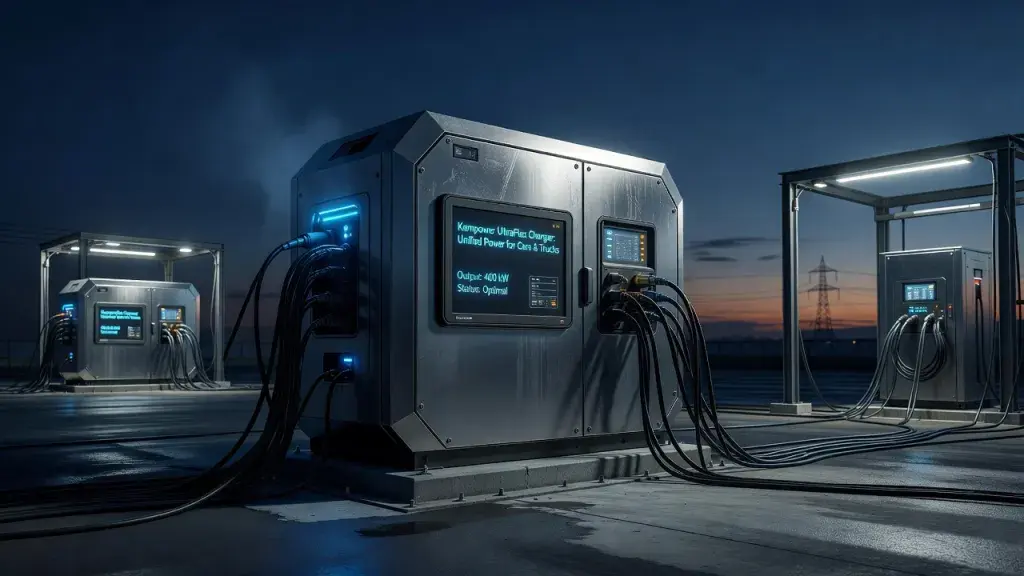
A single charging station that can fully power both a passenger sedan and a heavy-duty truck, without separate infrastructure, has been a persistent gap in the buildout of electric transport networks. Kempower says it has closed that gap with the Mega Satellite Flex, a dispenser unveiled this week that supports up to 560 kW via the established CCS standard and up to 1.2 MW through the emerging Megawatt Charging System, or MCS. It marks the Finnish company's first unit capable of switching between the two, rather than being built for one or the other.
The distinction matters because CCS and MCS serve different points in the same transition. CCS has been the workhorse connector for electric cars for years, and it remains adequate for most consumer vehicles, even as newer 800-volt platforms push it toward its practical ceiling. MCS, by contrast, was designed from the outset for freight trucks and buses that need to recharge large battery packs in the time a driver would normally spend on a mandated rest break. Building both capabilities into one cabinet means a charging site operator does not have to guess which technology will dominate traffic at a given location, or dig up pavement later to add a second system. It is a different kind of consideration from the privacy questions travelers weigh when connecting to public networks, such as understanding what your Wi-Fi owner can see on a shared connection, but it reflects a similar principle: infrastructure built for one narrow use case tends to age poorly as demand shifts.
Why shared infrastructure changes the economics
Charging hardware is expensive, and the land, grid connection, and permitting involved in building a site can cost as much as the equipment itself. A charger that only serves trucks sits idle whenever no trucks are present; one built only for cars can't capture revenue from the growing fleet of electric trucks moving through freight corridors. By supporting both standards, up to 1,500 amps for MCS and 700 amps for CCS, the Mega Satellite Flex lets operators capture utilization from mixed traffic immediately, rather than waiting years for truck volumes to justify a dedicated buildout. That utilization rate is the main lever operators have for recovering their investment faster, since the alternative, running a site below capacity for years, erodes the return regardless of how advanced the hardware is.
Practical details and where it fits into the current lineup
The unit ships with a 5-meter cable for CCS connections and a shorter 2.7-meter cable for MCS, reflecting the different vehicle geometries involved, and it can be fitted with a payment terminal for public-access sites. It also integrates with Kempower's existing distributed charging architecture, meaning operators already running Kempower systems can add the Mega Satellite Flex without replacing power cabinets or control systems already in the ground. That compatibility is arguably as significant as the dual-standard support itself, since it lowers the barrier for existing site owners to expand into truck charging incrementally rather than committing to a separate parallel network.
A signal of where truck charging is headed
Kempower revealed the charger at its Unplug & Recharge event held alongside ACT Expo, a venue focused on commercial and clean transportation technology, underscoring that the target customer is as much a logistics fleet operator as a retail charging network. The Mega Satellite Flex is slated for sale in North America and Europe starting in July 2026, giving the industry roughly a year to align site planning around a connector that can serve whichever standard proves dominant on a given route. Given how much capital is tied up in charging real estate, that flexibility may prove as valuable to operators as the raw power figures themselves.