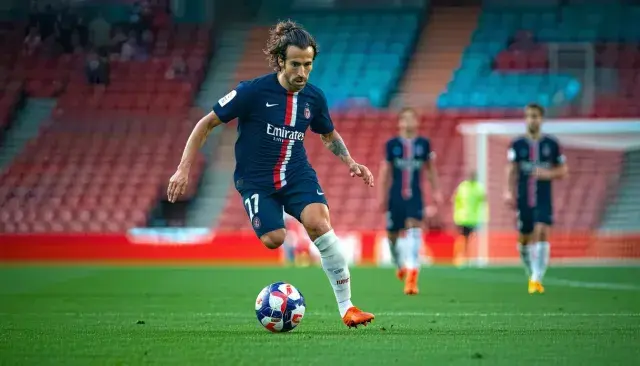

Adrien Rabiot heads into the 2026 FIFA World Cup as one of the more settled figures in a French squad that, despite its considerable depth, continues to rely on his particular blend of physical presence and technical composure in central midfield. After a productive spell at AC Milan following his departure from Juventus, the 29-year-old enters the summer with momentum and, unusually for a player of his profile, a clearly stated personal objective: to lift the trophy he came so close to winning in Qatar in 2022.
The Weight of a Near Miss
France's defeat in the 2022 final against Argentina remains one of the more emotionally complex chapters in recent French footballing history. A dramatic comeback that fell just short, decided on penalties, left a generation of players with unresolved business. Rabiot was part of that group, and he has not hidden the fact that the experience has shaped how he approaches the present cycle.
"The defeat in the last final was a mix of conflicting emotions," he told the official FIFA channel. "It's still a pleasant moment in my life - not everyone gets to play in a World Cup final. That defeat motivated me for the following matches, both with the club and with Les Bleus. I told myself that four years later, we'd be back and we'd win this time." The statement is not bravado. For France, reaching the semi-finals is, as Rabiot himself acknowledged, the minimum expectation. Falling short of that threshold would be read domestically as failure, regardless of the circumstances.
A Crowded Room, a Secure Position
What makes Rabiot's presence in the starting eleven particularly notable is the competition surrounding him. Didier Deschamps has access to a midfield generation of unusual quality. Aurélien Tchouaméni and Eduardo Camavinga are both established at Real Madrid at the highest level of European club football. N'Golo Kanté, despite his move to Fenerbahçe, retains his status as one of the most respected defensive midfielders of his era. Younger options - Warren Zaïre-Emery at Paris Saint-Germain, Manu Koné at Roma, Rayan Cherki now at Manchester City - represent the next wave pressing upward.
Against that backdrop, Rabiot's consistency has done the convincing. His box-to-box profile - the ability to contribute defensively while arriving late into attacking positions - fills a specific function that Deschamps values and that the French system has built around. His time at Milan has reinforced rather than disrupted that role, giving him regular high-level exposure ahead of the summer.
Mbappé, Leadership, and the Architecture of a Contender
Any discussion of France's prospects circles back to Kylian Mbappé, and Rabiot addressed this directly. "Mbappé is a leader: I met him in 2017 when he arrived at PSG, he was very young. Over the long term, he has proven to be crucial for every team he's played for, and now he's also much more mature." The observation carries the weight of proximity - Rabiot watched Mbappé develop across several years and is not offering flattery. He is describing an evolution that those inside the camp have observed firsthand.
France's strength is not, however, reducible to a single figure. Rabiot drew a pointed comparison: "When we play like we did recently against Brazil, we can beat anyone; the details make the difference in these tournaments." That framing - favourites without presumption, ambitious without complacency - reflects a collective posture that Deschamps has cultivated deliberately over multiple cycles. France entered 2022 as reigning world champions. They enter 2026 having spent four years processing what it means to be that close and come away empty.
What a Third Star Would Mean
France has won the World Cup twice - in 1998 on home soil and again in 2018 in Russia. A third title would place them among the most decorated nations in the history of the competition, alongside Brazil, Germany, and Italy in terms of sustained excellence at the global level. For Rabiot's generation specifically, players who have come of age during a period of French dominance without quite completing the final step, the 2026 edition carries the particular urgency of a closing window.
Rabiot is clear about where he stands: "We want that third star at this World Cup." It is the kind of sentence that reads differently when spoken by someone who has already stood on the final stage. He knows precisely what the path looks like and what it costs to fall short at the final hurdle.