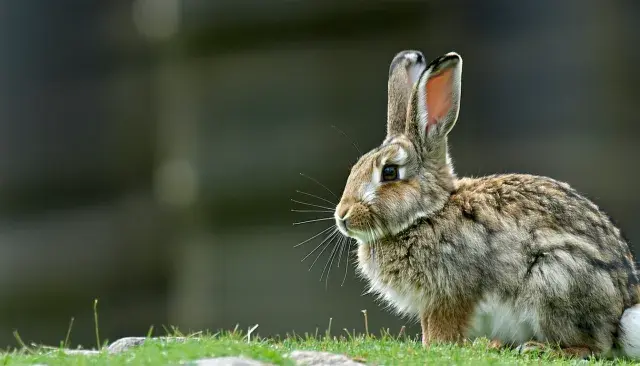

German photographer Luca Lorenz has been named 2026's Nature Photographer of the Year by the German Society for Nature Photography (GDT), recognized for an image so quietly extraordinary that many viewers struggle to locate its subject at all: an alpine hare, rendered nearly invisible against its mountain habitat. The award, presented through GDT's annual international competition, drew nearly 9,000 entries from 15 countries this cycle - a scale that underscores how seriously the global photographic community takes the task of documenting the natural world.
A Master of Disappearance, Hiding in Plain Sight
The alpine hare (Lepus timidus) has spent millennia refining the art of invisibility. Unlike many mammals that rely on speed or size for survival, the alpine hare invests in stillness and coloration. Its coat shifts seasonally - brown and grey in warmer months, turning white as snowfall deepens - a process driven by photoperiodism, the biological response to changing day length rather than temperature alone. This adaptation makes the hare a near-perfect visual match for the shifting textures of high-altitude terrain across the year.
Found across mountainous regions of Europe, from the Alps and Scotland to Scandinavia and northern Russia, the species occupies a particular ecological niche at elevations where few other small mammals persist year-round. It is a prey animal at the center of mountain food webs, sustaining populations of golden eagles, red foxes, stoats, and lynx. When alpine hare numbers fluctuate, the effects ripple upward through predator populations - making the species an important indicator of broader ecosystem health.
Lorenz acknowledged the weight of that ecology in his winning statement: "Alpine hares are deeply important to me and, in light of the significant challenges facing the species, raising awareness and supporting research into these extraordinary animals is more important than ever." Those challenges are real. Climate change is compressing the snowpack that alpine hares depend on for both cover and food, while warmer winters disrupt the timing of their coat transitions - leaving white-coated hares conspicuous against bare ground, exposed to predators during the critical mismatch period.
Photography as Conservation Argument
The GDT competition is explicitly structured around ecological purpose, not aesthetic display alone. The society frames its annual contest as a means of directing public attention toward what it calls "the finely balanced interaction of habitats, plants, animals, and microorganisms that sustains the vitality and resilience of our planet." That framing matters. A photograph of a well-hidden hare does something a scientific paper cannot: it places a general audience inside the experience of looking, searching, and eventually seeing - and in doing so, makes the act of noticing wildlife feel urgent and personal.
Lorenz's image exemplifies this approach. Its power does not come from dramatic action or saturated color, but from the intellectual moment when a camouflaged animal finally resolves out of the landscape. That delay - the viewer's frustration followed by recognition - is itself an argument for the hare's survival strategy and a reminder of how much is invisible in the natural world without disciplined attention.
A Gallery of Finalists That Refuses Easy Categories
The broader selection of finalists from this year's competition resists the tendency to reduce wildlife photography to spectacle. Among the standout images:
- A Eurasian curlew crossing the frame at JadeWeserPort, Germany's largest harbor project, photographed by Christian Kosanetzky - a deliberate juxtaposition of wild bird and industrial infrastructure that earned a tied second place in the "Birds" category.
- A young African bullfrog mid-leap, tongue extended toward prey it misses entirely, captured by Jens Cullmann - winner in "Other Animals" for a moment that is simultaneously comic and ecologically precise.
- An aerial view of active lava from the 2023 Litli-Hrúter eruption in Iceland, photographed by Jeroen Van Nieuwenhove - second place in "Nature's Studio," offering a view of planetary geology that no ground-level vantage could provide.
- An elephant calf sheltering from the Sun in Amboseli National Park, Kenya, captured by Preeti John of the UAE in an image that resembles charcoal on paper.
- Two male alpine ibexes engaged in a dominance dispute in late November - a behavior their photographer, Tobias Büttel, noted as unusual timing, since such confrontations typically resolve in summer to conserve winter energy.
- Bats arranged across a textured surface in an image by Linus Reimschüssel that reads as abstract art but is purely documentary.
- Two flies on a specimen of Clathrus archeri - commonly called devil's fingers - photographed by Julius Stratmann, finalist in the biodiversity category. The fungus releases foul odors not to capture insects but to recruit them as spore dispersers.
- A beech tree rising through dense fog, shot by Anja Diel near her home and awarded second place in "Landscapes." "Standing beneath the canopy of those towering beeches, I always feel tiny," Diel wrote.
What the Competition Reveals About the State of Nature Documentation
The diversity of subjects, geographies, and photographic approaches in this year's GDT finalists reflects a broader shift in how nature photography understands its own function. Where earlier decades of the genre leaned heavily on charismatic megafauna - lions, elephants, polar bears - contemporary competitions increasingly reward images of smaller, less celebrated organisms: bullfrogs, bats, fungi, hares. This is not a trivial aesthetic shift. It reflects a scientific understanding that biodiversity depends on the entire web of life, not only its most photogenic nodes.
The GDT's annual Nature Photography Festival, where finalist works will be displayed in person, takes place this October in Lünen, Germany. For Lorenz and his hidden hare, the occasion will carry particular significance. The alpine hare is not an endangered species, but it is a species under pressure - and the distance between "not endangered" and "declining" can close quickly and quietly, much like a hare dissolving into a mountainside when no one is watching closely enough.